


Fire alarm installation categories guide
Fire alarms 7 min read
Key takeaways
- Category M: Manual systems
- Category L1 to L5: Life protection systems
- Category P1 and P2: Property protection systems
Fire alarm categories help businesses choose the right system for their needs. Each category offers different levels of protection.
Understanding fire alarm categories
Each category serves a distinct purpose, providing varying levels of life and property protection. Systems are designed to meet specific needs and risks. Examples span from a Category M fire alarm system to an L3 fire alarm system or a P2 fire alarm system depending on risk.
Understanding these categories helps in planning a fire alarm strategy. For example, an L1 fire alarm system aims for maximum life protection, while a P1 fire alarm system focuses on whole-building property protection. Businesses should assess their building’s specific risks and requirements for optimal fire safety.
Overview of BS 5839-1 and UK fire alarm regulations
BS 5839-1 is the cornerstone for fire alarm system guidelines in the UK. This standard outlines key design and installation requirements for fire alarms. It ensures systems are designed to reduce risk and enhance safety. These requirements underpin commercial fire alarm system selection and ongoing compliance.
UK fire alarm regulations require businesses to install suitable systems. What these regulations require depends on the building’s use and risk assessment.
Key points covered in BS 5839-1 include:
- System design and installation
- Maintenance and testing requirements
- Guidelines for alarm zones
Manual fire alarm systems: Category M
Category M systems rely on manual operation by building occupants. These systems require individuals to activate call points during a fire incident. They are the most basic fire alarm system category.
Category M systems don’t have automatic detectors. Businesses must ensure that call points are easily accessible.
Despite their simplicity, Category M systems need regular maintenance.
Life protection systems: Categories L1 to L5
Life protection systems cover various risk levels. Categories L1 to L5 ensure life safety by offering different coverage.
Each category serves distinct needs. They range from full building coverage to specific area protection. Selecting the right one depends on the building’s risk assessment and layout.
- L1: Full coverage, highest protection
- L2: Escape routes and high-risk areas
- L3: Escape routes and the rooms that open onto them
- L4: Escape routes only
- L5: Customised for specific risks
L1 fire alarm system: maximum life protection
An L1 fire alarm system provides comprehensive coverage. Every part of the building, including rooms and escape routes, is monitored. This ensures the earliest warning of any fire.
L2 fire alarm system: additional life protection
An L2 fire alarm system enhances safety by covering escape routes and high-risk zones.
L3 fire alarm system: standard life protection
An L3 fire alarm system covers the escape routes and every room that opens onto them, so a fire in one of those rooms is detected before it can make the escape route unusable.
L4 fire alarm system: modest life protection
An L4 fire alarm system is simpler: detection within the escape routes themselves, such as corridors and stairways, and not in the rooms that open onto them.
L5 fire alarm system: localised life protection
An L5 fire alarm system matches its protection to specific identified risks in a building.
Property protection systems: Categories P1 and P2
Property protection systems focus on minimising property damage during a fire. P1 and P2 systems offer distinct protection levels to suit different buildings.
Choosing between P1 and P2 systems depends on the specific property needs and fire risks involved. These systems help reduce potential losses by providing targeted detection and alarms.
- P1: Total building coverage
- P2: Selected area protection
P1 fire alarm system: maximum property protection
A P1 fire alarm system delivers full building coverage, safeguarding every corner. It offers the highest level of property protection, detecting fires quickly throughout the premises.
P2 fire alarm system: defined property protection
A P2 fire alarm system focuses on designated high-risk areas, offering selective protection.
Fire alarm system design and installation considerations
Designing a fire alarm system requires careful planning. Consideration of the building layout and usage patterns is crucial. Different areas may have varied risks and require different levels of protection.
Fire alarm system design should also take into account future expansion needs. This flexibility can be vital for growing businesses. Expert consultation ensures the system meets all fire alarm regulations.
Proper installation is equally important. It should be done by certified professionals who follow fire alarm British standards.
Key aspects of system design include:
- Risk assessments
- Layout optimisation
- System integration
Central fire monitoring systems and integration
Central fire monitoring systems enhance building safety. They provide real-time remote monitoring and quick response. A central fire monitoring system can be crucial for large, complex buildings.
Integration with other systems is key. Fire alarms can be linked with security systems.
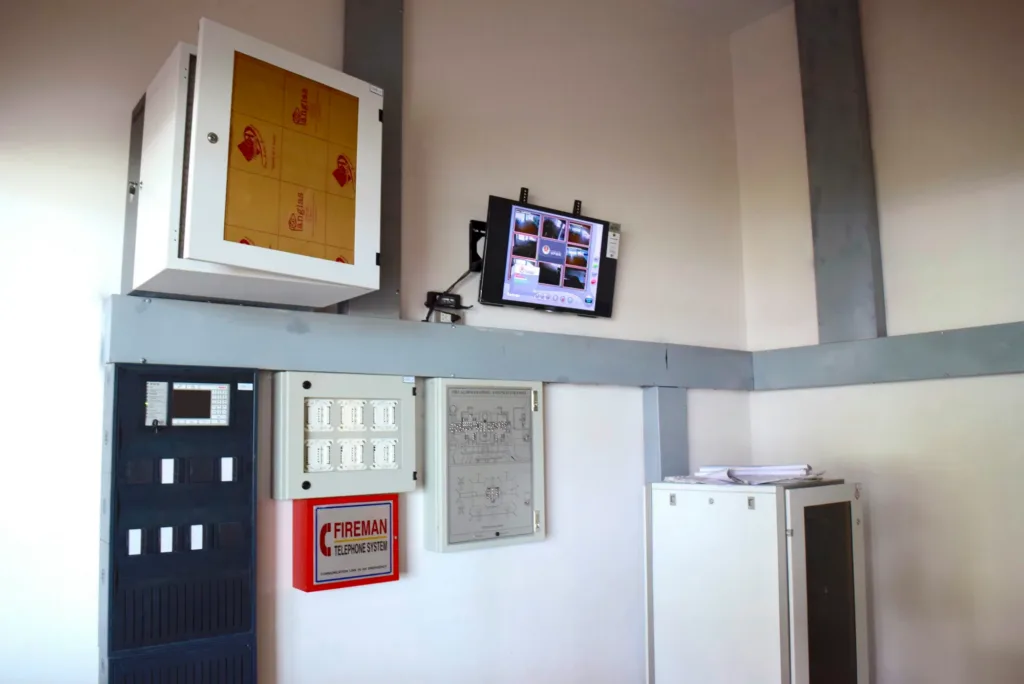
Central monitoring reduces response time. It ensures that emergency services are alerted promptly. Faster response minimises potential damage and improves safety.
Maintenance, testing and compliance
Testing should be a routine process. This helps identify and fix issues early.
- Schedule routine testing and inspections.
- Keep detailed records of maintenance activities.
- Update systems to comply with current standards.
Choosing the right fire alarm system for your business
Consult fire safety experts for guidance. Their insights can help you make informed choices. They consider potential fire risks and legal requirements.
Consider your budget and future needs. Investing in a reliable system can save money in the long run. Prioritise features that ensure safety and compliance for a commercial fire alarm system.
- Conduct a thorough risk assessment.
- Consult with fire safety professionals.
- Ensure the system meets both current and future needs.